Booking a family trip means one awkward question pops up fast: do you reserve two connecting rooms or splurge on one big family suite? The connecting rooms vs family suites decision affects your budget, your sleep, and how much everyone enjoys the trip. Get it wrong, and you may end up with a toddler waking a teenager at 6 a.m., or two rooms that cost far more than you planned.
This guide walks you through what each room type actually is, how they compare on space and privacy, and when one option clearly beats the other on price. We also cover safety for different ages of kids, practical booking steps so you actually get the layout you want, and how to match the room type to your destination, from city breaks to beach resorts. By the end, you should know exactly which setup fits your family and how to lock it in.
What Connecting Rooms and Family Suites Actually Are
The two options sound similar but work very differently in practice. Connecting rooms are two standard rooms placed side by side and joined by a lockable internal door. Each room keeps its own bathroom, its own entrance to the hallway, and its own everything else. You get what is essentially a private apartment split into two self-contained units, with the door between them under your control.
A family suite is a different animal: a single, large unit that typically ranges from 35 to 60 square meters. Instead of two separate rooms, you get one sleeping area plus a separate living space within the same unit, often with a sofa bed, a small kitchenette, or both. There is usually only one bathroom and one entrance, and everyone shares the same air and noise.
Watch out for misleading labels
Here is where things get tricky: some hotels label a junior suite as a family suite even though it has no separate room at all. You may pay suite prices for what is really a standard room with a slightly bigger footprint and a pull-out sofa. Before you book, check the floor plan on the hotel’s website or ask them to describe the layout in plain terms. Ask whether the sleeping area is a genuinely separate room or just a corner of one open space, and how many people the room is officially rated to sleep. A few minutes of checking here saves you from an unpleasant surprise at check-in.
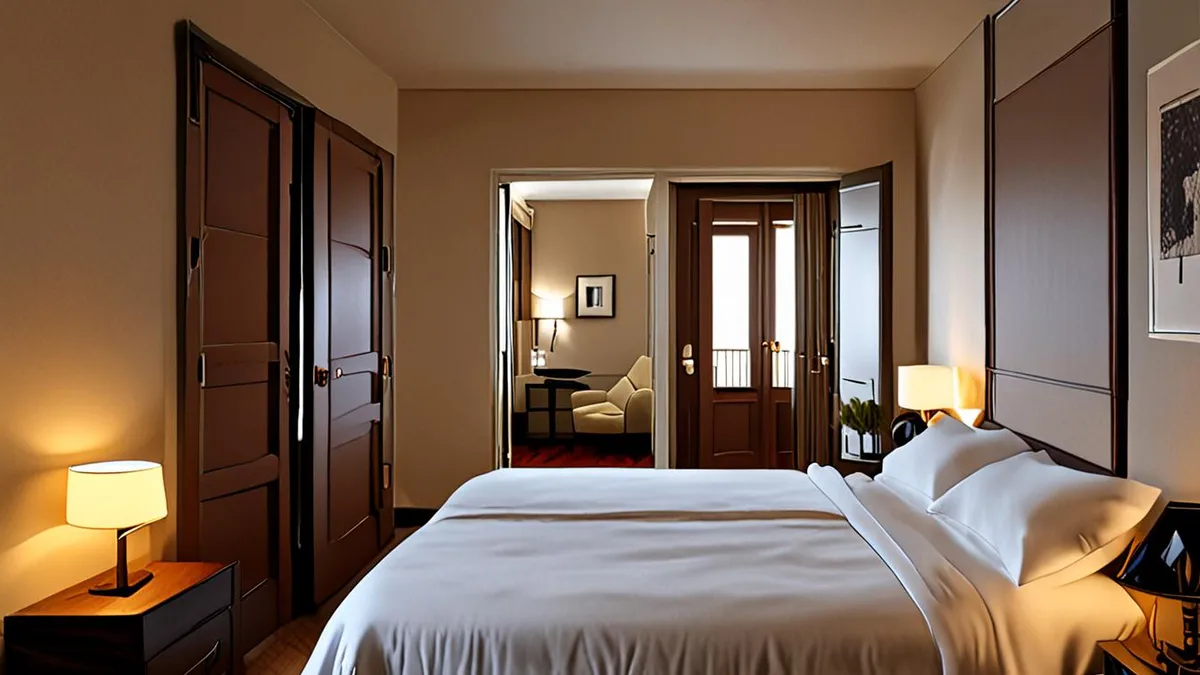
Privacy is the biggest dividing line between these two setups. With connecting rooms, parents and children get fully separate bathrooms, separate TVs, and separate bedtime schedules. Teenagers can stay up late watching shows while parents sleep, and nobody tiptoes around anyone. Each side of the connecting door genuinely feels like its own room, because it is.
A suite of 35 to 60 square meters keeps everyone in one shared space instead. That sounds like a downside, but for parents of babies and toddlers it is often a plus: you can see and hear your young kids from anywhere in the unit, and there is no hallway between you at night. One bathroom does mean morning queues, though, so factor that in with older kids.
How many people are you actually traveling with?
Family size usually settles the debate on its own. Most suites are officially rated to sleep only 3 to 4 people, so families of 4 or more usually need connecting rooms to fit comfortably and legally. A suite with a sofa bed can sometimes squeeze in a third child, but everyone gives up privacy and elbow room to make it work.
- Check official occupancy limits, not just bed counts. A suite might physically fit five people on a sofa bed, but the hotel may cap the room at four guests, and exceeding it can mean extra fees or a refused check-in.
- Ask about bed configurations before booking. Some suites offer one king bed plus a single, others two doubles, and a few add a rollaway for a fee. The layout you get on arrival is not always the one pictured online.
- Consider the bathroom math. Two connecting rooms usually mean two bathrooms, which halves the morning bottleneck for a family of four or five getting ready for a day out.
Space and Privacy: How Each Option Fits Your Family
Connecting rooms shine when different family members need different schedules. The kids can watch cartoons in their own room and fall asleep at 8 pm while parents stay up reading or working in theirs, each with a private bathroom and TV. Nobody has to whisper after bedtime.
A family suite of 35 to 60 square meters works differently. Everyone shares one unit with a sleeping area plus a living space, so a toddler napping on the sofa bed while older siblings play quietly is easy to manage. You can hear a crying baby instantly, and there is no hallway door between you and your children.
Family size often decides the matter. Most suites comfortably sleep three or four people, so a family of four or more typically needs connecting rooms to get enough beds. A suite can stretch to fit a third child with a sofa bed, but you trade away privacy and personal space to do it.
- Bathroom count: Connecting rooms usually come with two full bathrooms, so a family of five can shower and get ready for breakfast in half the time.
- Sofa bed trade-off: A suite sleeping a third child on the sofa bed means that child’s bed doubles as the living room seating, so evening downtime happens on made-up beds or around a small table.
- Storage and clutter: Two connecting rooms give you two wardrobes and two desks, which helps when teenagers have schoolwork or everyone unpacks for a week-long stay.
- Noise spread: In a suite, one fussy sleeper can disturb everyone in the room; with connecting rooms, a snoring grandparent or restless toddler is behind a closed door.
Cost Comparison: When Two Rooms Beat One Suite
Price is where connecting rooms take the hit. Because you are paying for two full rooms instead of one, two connecting rooms often run 20 to 40 percent more than one comparable suite at the same property. For a week-long stay, that gap can add up to a meaningful chunk of your activity budget, so it deserves a hard look before you book.
That said, the sticker price is not the whole story. Many suites come with a kitchenette, and that small kitchen can quietly become your best money-saving tool. Being able to prepare breakfast, pack lunchboxes, and cook a few dinners can cut food spending by 30 to 50 percent on week-long stays, especially in expensive destinations where every restaurant meal for a family adds up fast. A suite with a higher nightly rate can end up cheaper overall than two rooms plus three meals a day eaten out.
The per-person pricing trap
Some resorts, particularly all-inclusive properties, price per person rather than per room. In that setup, two rooms for a family of 4 can become disproportionately expensive, because you are paying two full room rates plus per-person charges on top. Before booking, ask the resort to quote the total for your exact family size under both configurations. Sometimes the “cheaper” room type is the pricier option once you run the real numbers.
Timing matters here too. Rates for both room types swing with the season, and booking at the right moment can shrink the gap between two rooms and one suite. If you want to plan your booking window properly, it helps to understand when to book hotels for the best rates before you commit to either option.
Safety and Convenience for Different Ages of Kids
The right room type often comes down to how old your kids are. A teenager who rolls their eyes at a 9 p.m. lights-out rule will appreciate connecting rooms, where they get their own door, their own bathroom and a genuine sense of independence. Parents get privacy too, without being floors apart like they would with separately booked rooms.
Suites work in the opposite direction. With babies and toddlers, you want everyone within arm’s reach, and a single open space of 35 to 60 square meters lets you hear every stir from the crib without a baby monitor. There is no internal door for a curious three-year-old to wander through at 2 a.m., which alone is reason enough for many parents of little ones.
Security-minded parents also like that internal connecting doors typically lock from both sides. You can secure the door at night or while the kids play, and so can the kids on their side. If your suite has a kitchenette, you gain another practical layer: bottle warming at 5 a.m. and early breakfasts without waiting for a restaurant to open or hauling the whole family down to the lobby.
- White noise and sleep schedules: in a suite, one early riser can wake everyone, so pack a portable white noise machine; connecting rooms let early birds start the day in their own room without disturbing siblings.
- Door safety for crawlers: some hotels provide door guards or high-mounted latches on request, worth asking about if your toddler opens every door in sight.
- Fridge access: a suite kitchenette keeps milk, snacks and medication refrigerated overnight, something a standard room in a connecting pair usually cannot offer.
- Chaperone distance: with teens in connecting rooms, you are one unlocked door away rather than a phone call, a good middle ground between supervision and freedom.
How to Book Connecting Rooms vs Family Suites Successfully
Connecting rooms are among the most requested configurations in family travel, and hotels hold only a limited number of internal doors in their floor plans. That means the room type you want can disappear long before the hotel itself sells out. The frustration is real: you arrive with kids in tow, only to learn your rooms are on different floors or, worse, not connected at all. A little extra effort at booking time dramatically improves your odds of getting the setup you actually paid for.
- Book early for high season. Request connecting rooms 2 to 3 months ahead if you are traveling during school holidays or peak summer. Inventory is limited, and even when a booking site shows availability, a connecting configuration is never guaranteed at the time of booking.
- Call the hotel directly. Online reservations rarely capture special requests reliably. After booking, phone the hotel, reference your confirmation number and ask the front desk to attach the connecting-room request to your reservation in writing.
- Get suite details in writing. Before paying for a family suite, confirm the sleeping capacity and exact bed configurations by email. Some suites sleep only 3 to 4, and a “sofa bed” that is really a loveseat can upend your plans.
- Check recent guest reviews. Descriptions and floor plans can lag behind reality after renovations. Reading what recent guests say about the actual room layout helps you confirm the setup matches what was promised.
- Reconfirm before arrival. A quick email or call a few days before check-in gives the front desk a fresh reminder and gives you time to adjust if something has changed.
Spending twenty minutes on these steps can save you from arriving with four family members and two rooms that do not connect. It also gives you a paper trail if the hotel needs to make things right. If you want to sharpen your review-reading skills before you book, it helps to know how to read hotel reviews and spot red flags before booking, since layout complaints are one of the most common themes in family-travel feedback.
Matching Room Type to Trip Style and Destination
The best room type depends heavily on where you are going and how you plan to spend your days. A room that feels perfect for a week at the beach can feel cramped on a city break, and vice versa. Match the room to the trip, not the other way around.
Beach and all-inclusive resorts are built around suites. A terrace or balcony becomes shared family downtime space: morning coffee while the kids watch the water, or an evening wind-down after the pool. City trips tilt the other way, because standard rooms in urban hotels usually measure only 20 to 30 square meters. Two connecting rooms effectively double your living space, which matters when you are all changing for dinner in the same compact room.
Length of stay is another deciding factor. On trips of a week or more, a suite with a kitchenette pays for itself by cutting restaurant dependence, and having a separate living area makes long evenings far more pleasant. Resort-style trips with strong kids’ clubs work differently: if your children are out doing crafts and games most of the day, you need far less in-room space than you think.
- Check what is already included: many all-inclusive resorts bundle kids’ club access, meals and activities into the rate, so a smaller room may leave more budget for excursions or spa time.
- Think about nap logistics in cities: sightseeing days mean late returns and tired kids, and a suite’s separate living area lets adults talk or read after the children fall asleep on the sofa bed.
- Consider laundry on long stays: a kitchenette suite often pairs with in-unit or guest laundry, which halves the packing for trips longer than a week.
- Match the property type first: if you are unsure whether a hotel, resort or boutique stay fits your family’s style, it helps to compare what each type of accommodation actually offers before choosing a room category.
The Bottom Line for Your Family
So which option should you book? If you are traveling with a family of four or more, connecting rooms usually win on privacy and space. Everyone gets their own room, bathroom and bedtime routine, though expect to pay roughly 20 to 40 percent more than you would for one suite.
For smaller families, especially with young children, a single suite often delivers better value: one open, shared space to keep an eye on everyone, usually at a lower nightly rate than two separate rooms. Whichever setup you lean toward, book two to three months ahead for high-season travel and confirm the exact room layout directly with the hotel before you pay. Have you stayed in either arrangement with your kids? Share your experience in the comments or pass this article along to another traveling family.